Does socialism abolish private property?
The meaning of "the means of production"

The concept of justice, as applied to social systems, has two components: an account of individual rights and an account of how the fruits of cooperation are to be distributed.
The various conceptions that fill out the concept of justice differ in what rights they recognize and in how they would distribute the fruits of cooperation.
Two things typify capitalist-friendly conceptions of justice. One is that they invoke “natural” economic rights, i.e., expansive individual rights to appropriate resources and to enjoy “despotic dominion” over what’s appropriated —which can be almost anything except unwilling persons. The second is that the distribution of property acquired by exercise of these rights, or received in voluntary exchange, counts as just, however unequal it may be. Patterns don’t matter.1
A socialist conception differs in both respects. Unfortunately, it is all too easy to land in a muddle when specifying those respects.
Socialism arose in the 19th century as a reaction to industrial capitalism, and socialism’s opposition was often overstated. So, socialists invited the accusation that they meant to abolish private property —as indeed quite a few socialists (and many anarchists) did propose. It was not uncommon to hear socialism defined as abolition of private property and common ownership of the means of production —as if these were flip sides of one and the same coin.
Many socialists, though, had no wish at all to abolish private property. These socialists nonetheless insisted upon common —not private— ownership of the means of production.
But isn’t that the same thing?
Well, that depends on what the meaning of “the means of production” is.2 What is it?
Were the phrase taken literally, it would encompass practically anything and everything that could be put to productive use.3 And if socialists want to abolish private property in anything that could be put to productive use, then they might as well ‘fess up and say Yes, we mean to abolish private property, full stop.
That line of argument merely shows why the literal reading is no good.
A compact formula that encapsulates the socialist’s actual idea is this:
The means of production of a given society, at a given time, comprises those resources and instrumentalities that are both
1. widely indispensable means of productive activity, or whose products are; and
2. impossible to be severally owned.
“[S]everal ownership” is practicable ownership —especially the right to exclusive use and enjoyment— by each and every person, individually. A shovel does not belong among the means of production, because it is easily possible for everyone to own —to have by right the exclusive use of— his or her own shovel, and the utility (use-value) of owning a shovel is not diminished by everyone owning one. A highway system, on the other hand, does belong to the means of production. A single person or group might own the highway system, but several ownership of the highway system is absurd. If everyone owned his or her own stretch of highway, there would be no highway system. Unlike shovels, the utility of highways depends on their forming a more-or-less continuous network.
Similarly, units of a currency may be severally owned, but the currency itself belongs to the means of production. We cannot each of us issue a currency. Of course, we can give out coupons and chits and occasional IOUs —but this is a far cry from the kind of common currency that makes commerce possible. Collective ownership of the currency is possible. Monopoly or oligopoly ownership of currencies is possible. But several ownership of a currency is not.
Common ownership is a different concept from several ownership. Several owners have the right to exclude others from their several parcels; common owners do not have the right to exclude others from the commons (hence the risk of “tragic” overuse).
Share ownership is a different concept from several ownership. Corporate shareholders have rights to a share of whatever dividends the directors choose to distribute; and, typically, shareholders have voting rights. Shareholders typically do not have a right to a several parcel of the corporation’s assets (except upon its liquidation, if anything is left after the prior claims of its creditors are satisfied). Normally, a mere shareholder has no more right to access, use, or enjoy the corporation’s assets than a non-shareholding member of the public has.4
Socialists and Communists often found themselves on the back foot, fending off the accusation that what they want is to confiscate everybody’s stuff and toss it into a common pot. What was actually in their sights wasn’t hand tools (much less, personal items generally), but what Engels in 1847 called “big industry.” In 1892, Karl Kautsky remarked that
the modern instruments of production are extensive and powerful. It has become wholly impossible that every single worker should own his own instruments of production.
In 1922, once the Bolsheviks had secured their victory, Lenin directed attention to “the commanding heights” of the economy, leaving be the rest of the private sector. Two years earlier, Lenin’s “golden boy,” Nikolai Bukharin had explained:
It is self-evident that we were not concerned with the expropriation of small-scale industry or with the expropriation of artisan production, but with the seizure of the means of production that were in the hands of the great capitalists, with establishing large scale industry upon a new foundation.
The opponents of communism have always… declared that the communists wanted to confiscate everything and to divide everything up; to parcel out the land, to divide up the other means of production.… Nothing could be more absurd than this notion. Above all, such a general division is impossible. We could share out land, horses and cattle, money, but could not share out railways, machinery, steamboats, and various other things of the sort.
This is what actual Communists had to say. And Bolshevism was but one strain of socialism,5 and an extreme one at that.
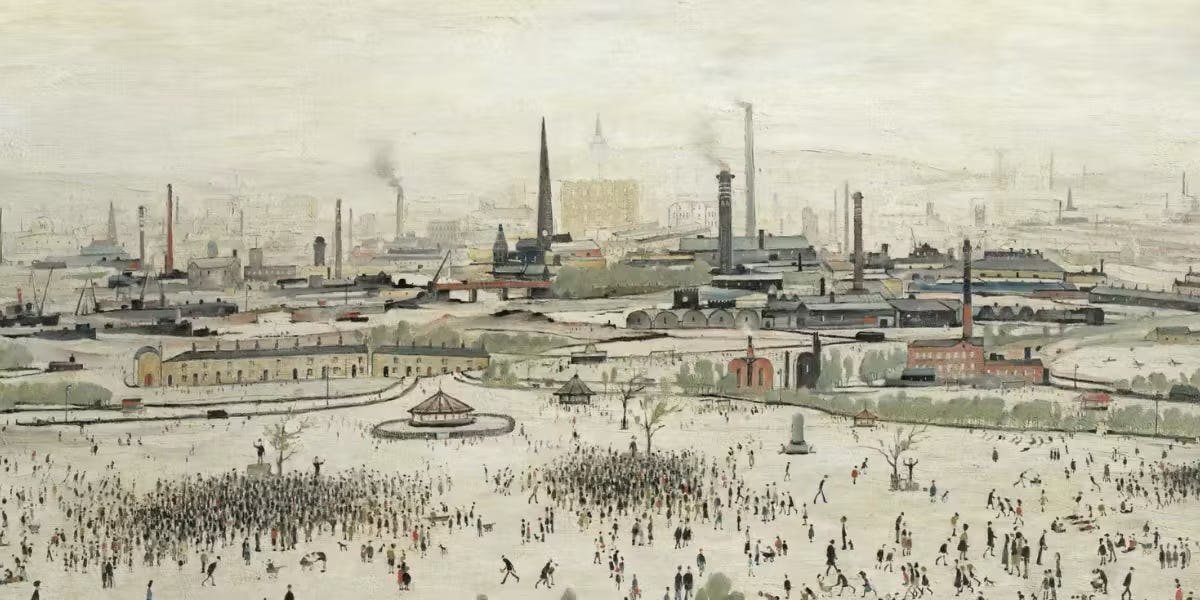
Recall that socialism was a response to the world-historical advent of methods of production that profoundly altered social relations. In the early 19th-century Midlands of England, the power loom replaced the hand loom, and the skilled weaver became a deskilled proletarian at the mercy of the private mill owner. These coal-and-steam driven means of production were something new under the sun.
There is no certainty that there will be anything answering to [the above two] criteria in every place and era. In certain extremely primitive, hand-to-mouth circumstances, there might only be simple tools that can only be manipulated by a single handler. “The means of production” do not yet exist. Looking ahead, maybe some day every person will own his or her very own personal, self-maintaining, [AI-assisted] solar-powered 3D printer that converts air into food, clothing, housing, transportation, entertainment, and whatever you will. The means of production, as defined [above], would no longer exist.
Set these extremes aside. Now and around here, the means of production include the currency, the highway system, the military, the postal service, parks and wildernesses, the broadcast spectrum, telecommunications, power generation and distribution, navigable waterways, credit, investment banking, insurance, weaponry and munitions, airways, railways, hospitals, agribusiness, many extractive industries, petrochemicals, internet service providers, Facebook, Amazon (especially Amazon Web Services), Google, and so forth. We can imagine everyone having a share (equal or unequal) of the revenues of such things, and we can imagine everyone having a say (equal or unequal) in the overall direction of such things. But we cannot imagine dividing such things into separate, exclusive parcels. If we imagine distributing these things to each, we find that we have hugely and even radically diminished the whole. We can imagine everyone self-insuring, for example, but that amounts to imagining that the institution of insurance no longer exists at all.
The key thing is not bigness. Not everything that happens to be a big business that supplies something that is meant to enable productive activity is included in the means of production. Coca-Cola and the caffeinated beverage industry to which it belongs are big business, but are not among the means of production —except possibly on a local scale, as might be the case in a small town in which the soda-bottling plant is the major employer.
Something might belong to the means of production on a wide scale, but it does not follow that every local or small-scale part does. A farmer’s shovel or tractor does not belong to the means of production merely because the farmer’s small operation is functionally integrated into larger operations that can properly be called agribusiness….
The information age has taken us beyond the industrial revolution in significant ways. Control of a platform conveys with it enormous power over those who need to use it to engage in productive activity or to market what they produce. Apple’s App Store is an example. As a condition for the privilege of marketing the apps they design for the iOS operating system, developers must agree to let Apple make the app obsolete by Apple’s copying it and incorporating the copy into iOS. A single device is not part of the means of production, on my analysis, but the platform it runs on could be, and in the case of iOS, it is.
What socialism aspires to is a society in which everything that can be severally owned is within reach of everyone who cares to own such a thing. And in which things that are not severally ownable, but are necessary to living productively, are owned in common.
Common ownership might take any of several forms. It might be state ownership. It might be ownership by those who apply their labor to particular means.
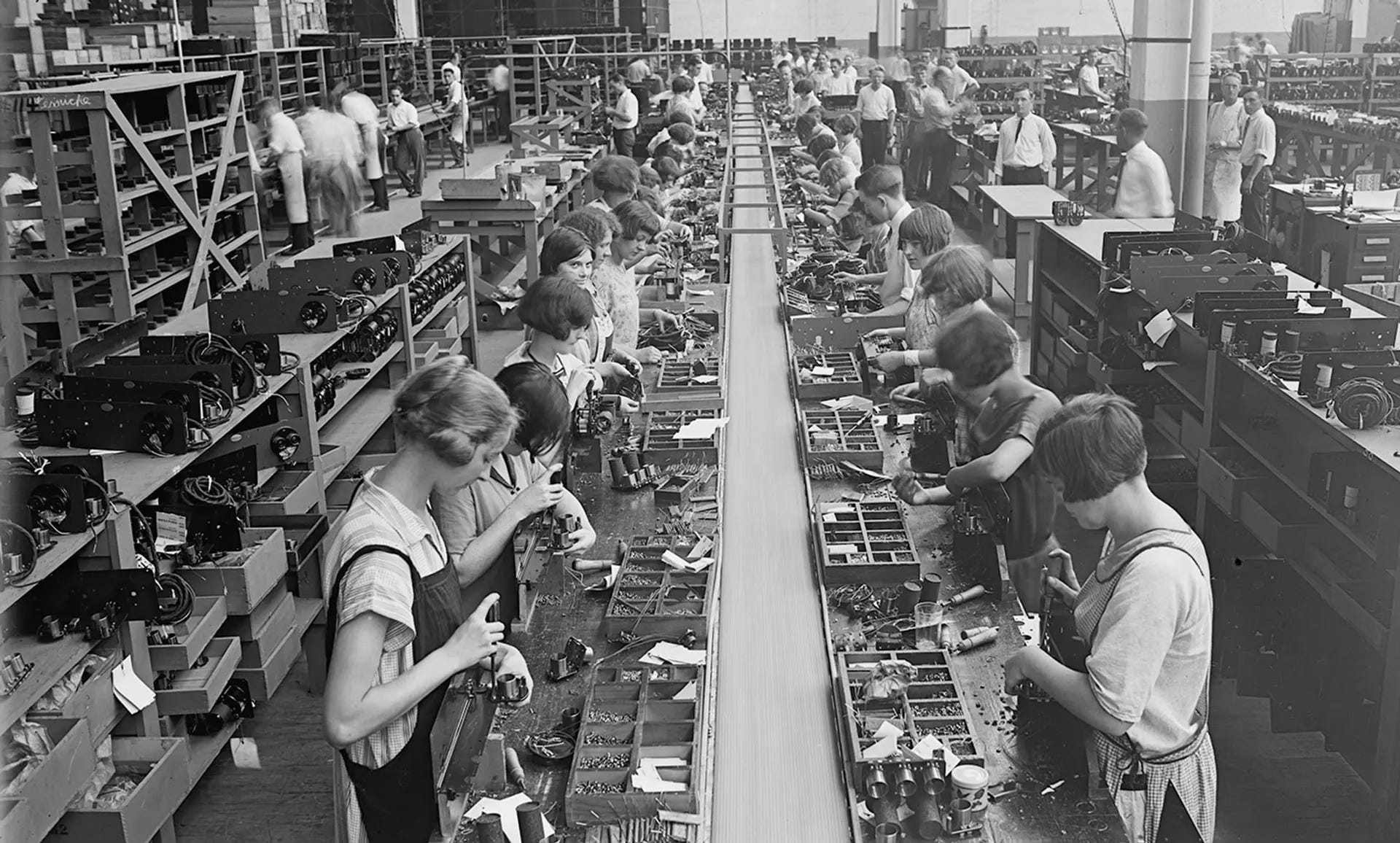
It might mean share ownership by each and all —not everyone can own an assembly line, but everyone can own a share in the firm that runs one. (Of course it would mean chaos if it were attempted to give everyone an exclusive, physical piece of the assembly line.)
Matt Bruenig explains how share ownership is a first step toward socialism. Have a look.
You might be a socialist because you believe, as a matter of first principle, that the means of production ought to be socially not privately owned.
Or you might be a socialist because you think that private ownership of the means of production undermines some other fundamental principle, like political equality.6
In either case, you are logically free to be a socialist who wants not to abolish private property but to make it abundant for all.
This is at least the gist of Robert Nozick’s view, as set out in his Anarchy State and Utopia (1974). Nozick later confessed the book simply assumed “strong” economic rights for which he had not supplied an argument.
It depends on this, and not on the definition of private property. Socialists invite confusion when they say, as Vivek Chibber does, that socialism wants to abolish private property, only to take that right back, and say that socialism gives a special spin to “private property,” such that “cars, shoes, or televisions” don’t count as private property. Were he instead defining the means of production, he’d be hitting the nail on the head when he goes on to say, “It’s property that is a productive asset, the control of which allows you to have control over other people, because they now have to come to you to make their own living.”
Critics of socialism have been happy to focus on the literal. Thus, Austrian economist Ludwig von Mises: “All the means of production are in the exclusive control of the organized community. This and this alone is socialism. All other definitions are misleading” (von Mises, L. 1951 [1922], Socialism : An Economic and Sociological Analysis, p. 239). Emphasis on the all. “Without private ownership in the means of production there is, in the long run, no production other than a hand-to-mouth production for one’s own needs“ (p. 511). A prominent theorist of socialism, Jerry Cohen, took literalism a step further, speculating that a laborer’s teeth might count among the means of production. (Cohen, G. A. 1978. Karl Marx’s Theory of History: A Defence, p. 55.)
Except where otherwise indicated, this and subsequent block quotes are from William A. Edmundson, “What Are ‘The Means of Production?” The Journal of Political Philosophy 28(4): 421–37 (December 2020).
Graham Wallas approached the problem from a different angle in Fabian Essays in Socialism, (G. Bernard Shaw, ed., 1889):
Socialists [do not] contemplate any need for preventing individuals from working at will on their possessions in such a way as to make them more valuable[, and conducting] a profitable trade…. [For] whatever things of this kind we allow a man to possess, we must allow him to exchange, since exchange never takes place unless both parties believe themselves to benefit…. There would remain therefore to be owned by the community… the materials of those forms of production, distribution, and consumption, which can be conveniently be carried on by associations larger than the family group….
By implication, Wallas would also allow individuals the liberty to hire and be hired into productive units more extensive than the family group. (An aside: Yugoslavia restricted non-family employment on private farms to five; but did not limit family size. The farms could be no larger than 10 hectares.)
Wallas thought “old evils of capitalism” would still be avoided because
if any change in the habits of the people or in the methods of industry … made associated production of any commodity on a large scale convenient and profitable, [it] would result at once in the taking over of that industry by the State…. (my emphasis).
The taking over was normally to be done by the then-new county councils rather than the national government.
The Fabians thus carved out an uncertain and needlessly cramped space for not-too-large private enterprise. Thomas Piketty has recently put forward a similar idea, but favoring employee control. For the Old Mole’s critique see here.
See John Rawls. 2001. Justice as Fairness: A Restatement, pp. 176-78.
Thank you,Old Mole, for this very clear and helpful analysis of a profoundly important aspect of socialism, and for addressing a widespread misunderstanding of what the term means.
It still does not convince me to agree or become one